Shadow work, out loud.
The animal you cannot stand
is the one running your life.
Choose six animals that feel like you. Then the one that makes your skin crawl. That seventh is your shadow: the part of yourself you pushed away so early you no longer remember doing it. It has been making your decisions ever since. Symponia is an AI companion for shadow work. You talk to it, out loud or in writing, and it answers.
Depth psychology, not therapy. Built on Jung, Hillman and the old language of archetypes.
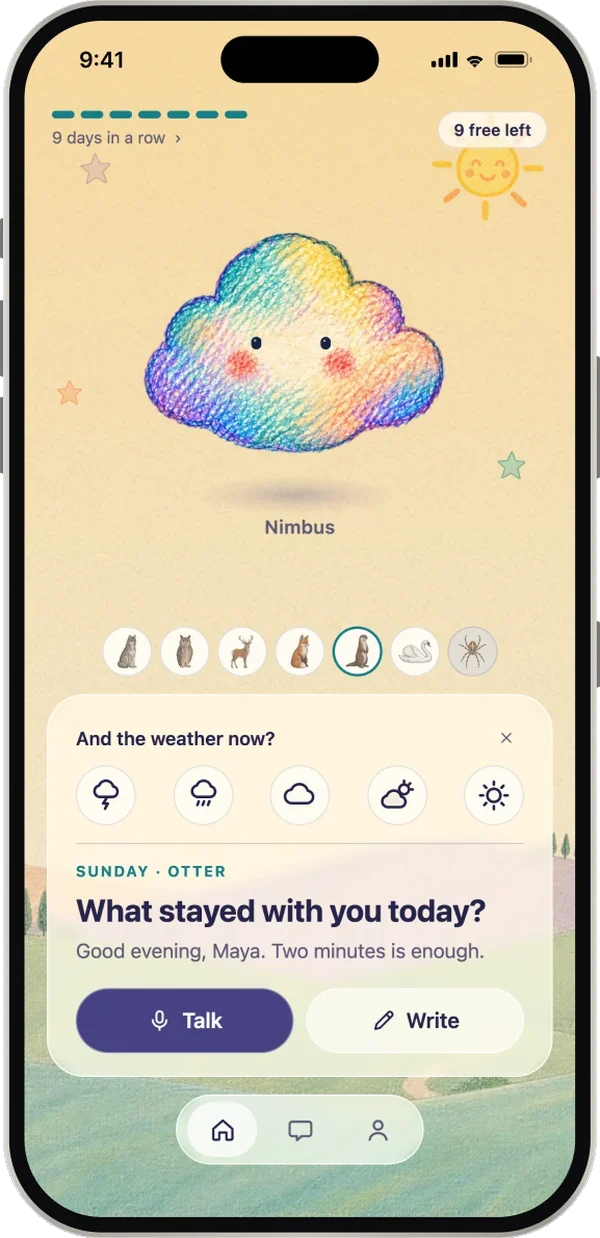
Recognition
Which one of these is yours?
I know exactly why I do it. I do it anyway.
I can explain my patterns in detail. I still cannot stop repeating them.
The thing I judge hardest in other people is the thing I never let myself be.
I get close to what I want, then quietly sabotage it.
I heard myself speak in a voice I recognised. It was my mother’s.
I have journalled about this for two years. Nothing has moved.
Why it keeps happening
What you cannot stand in others is what you buried in yourself.
Jung called it the shadow: everything you learned, early and without consenting, was unacceptable about you. It does not leave. It goes underground and runs things from there, which ambitions you allow yourself, which rooms you shrink in, which people you cannot forgive. Psychologists call the mechanism projection. It is not a character flaw. It is an old survival strategy that outlived its usefulness.
The shadow is not your trauma, and it is not the worst of you. It is the part you refused. Jung’s claim was that it holds as much of your unlived strength as it does your unlived shame, which is why leaving it buried costs you twice.
Symponia only ever hears one side. Yours. That happens to be the only side you can change.
The idea in one picture
What shadow work is, and where Symponia fits.
Shadow work is an old idea from the psychiatrist Carl Jung. The traits we push away do not leave. They turn up in what we cannot stand in other people. The work is to notice that, kindly. Nobody can promise where it leads, but the steps are simple.
A reaction bigger than the moment
Someone is smug, needy or cold, and it gets under your skin far more than it should.
In SymponiaYou name six animals you feel drawn to and one you cannot stand. That seventh animal is a quick way to find the reaction.
A question, not a verdict
You ask what the reaction might say about you. Jung called this projection: seeing in others what we have disowned in ourselves.
In SymponiaYour cloud asks about the pattern and reflects back what it hears. It does not diagnose, and it does not tell you who you are.
Saying it plainly
You put it into words, out loud or on paper. In one brain-imaging study, naming a feeling was followed by a calmer response in the part of the brain that reacts to threat.
In SymponiaYou talk by voice or write. You choose how you are spoken to: short and direct, warm and plain, or deep and philosophical.
Catching it as it happens
Over days you start to notice the pattern while it is happening. That is the only moment you can choose something else.
In SymponiaA small check-in before and after each talk shows how you arrived and how you left, week by week. When things feel heavy, there is breathing guided by voice.
Shadow work is reflection, not treatment. If you are struggling, a therapist or your doctor is the right person to talk to. The study on naming feelings: Lieberman and colleagues, Psychological Science, 2007.
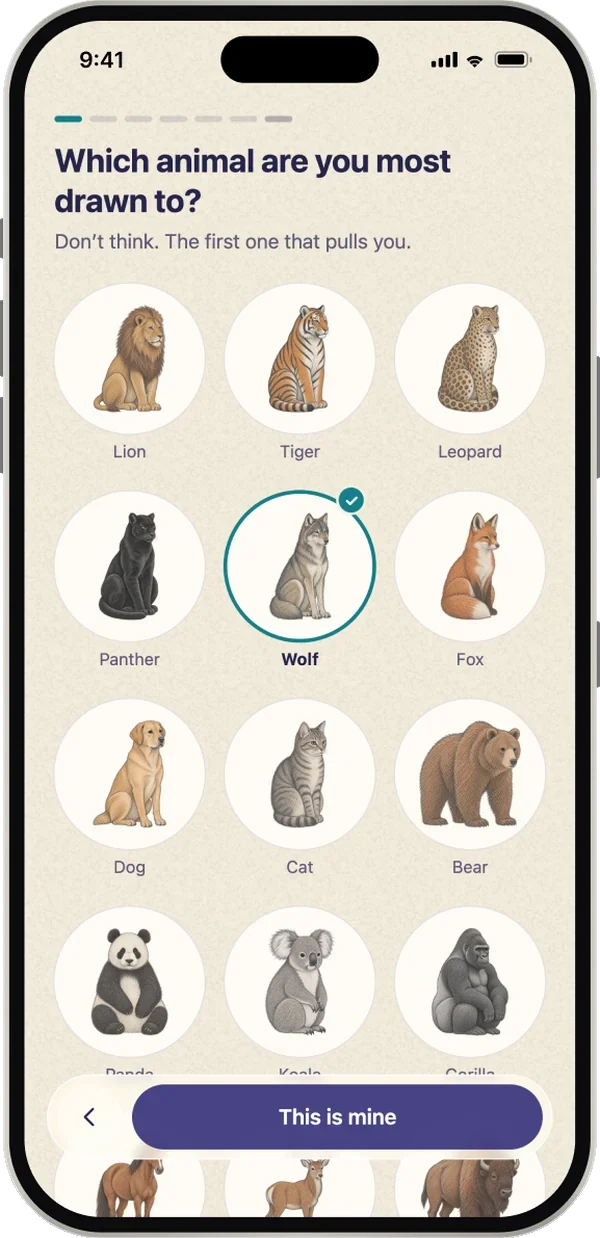
The seventh animal
Six animals that feel like you. One that makes your skin crawl.
Name six that belong to you. Then name the one that repels you. That seventh is the most important of all, because it holds what the other six cannot carry, and your revulsion is the tell. You do not recoil from what is foreign to you. You recoil from what is disowned.
Each animal is read for its gift, its shadow, and the path between them. Symponia reads the whole set together. Nothing is assigned to you: this is a projective method, not a personality type. It is a lens, not a label, and it will never tell you your spirit animal.
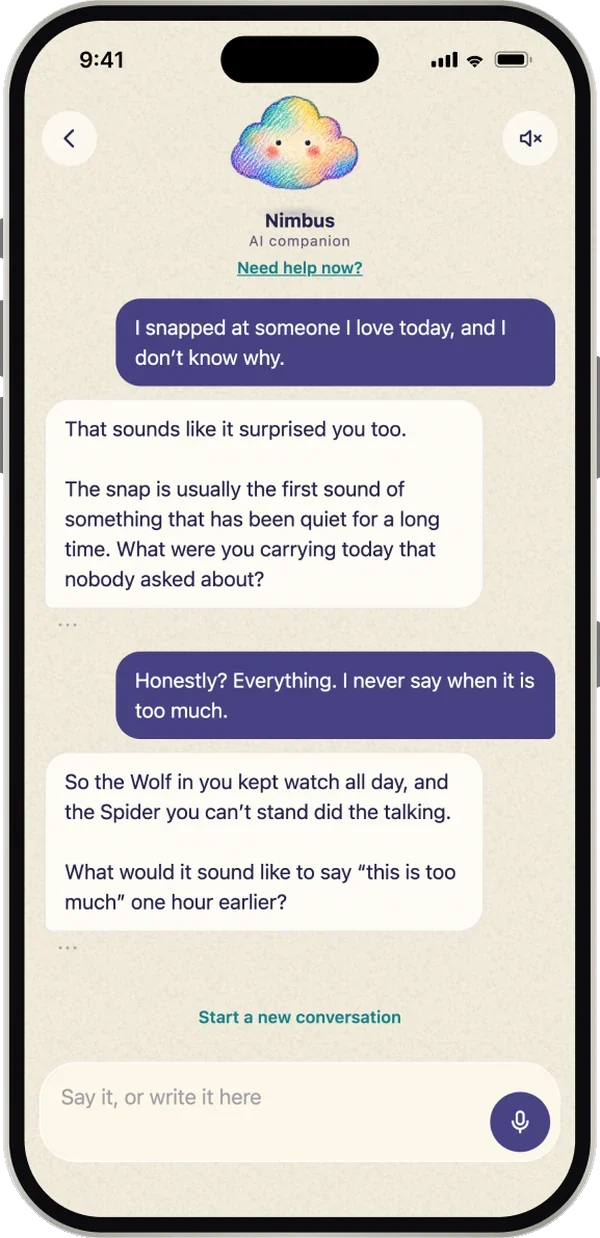
Out loud
Say it out loud. It answers.
Some things are easier to say than to type. Tap the microphone and talk. Your cloud listens, thinks, and answers in a calm voice of its own. Prefer quiet? Write, and read the reply. It is the same conversation either way, and you can switch whenever you like.
Three ways to be spoken to
Short and direct
One or two plain sentences, and one thing you can actually do. No poetry.
Warm and plain
Like a friend who gets it. Everyday words, and the feeling that you were heard.
Deep and philosophical
For when you want to go all the way in: pattern, shadow and archetype, without the fog.
Try it here
Find your seventh animal, on this site.
Pick six animals you feel drawn to and one you cannot stand, and get a short reflection on what the seventh can point to. It takes two minutes, it is free, and there is nothing to sign up for.
The difference
Most shadow work apps hand you a prompt and leave you alone with it.
Read the reviews of any of them and the same sentence keeps surfacing: and then nothing happened. A prompt cannot see you. It asks the same question of everyone and has no idea what you answered last time. Symponia meets what you bring at its full weight, and every reply lands on the one thing that takes you a layer deeper.
What is the trait that irritates you most in other people?
People who need things from others. It makes me want to run.
And if needing were allowed in you, what would it be asking for?
To be looked after, I suppose. I have never let anyone do that.
Then the thing you run from in them is the thing you have never allowed yourself.
Nine languages
In your own language.
Your inner life does not happen in your second language. Symponia works in English, Swedish, Italian, Russian, Portuguese, French, German, Spanish and Danish. Choose yours on the first screen, and every screen, every reminder and your cloud itself use it.
Memory
It gets to know you. Only if you say yes.
You should not have to reintroduce yourself every Tuesday. But the thing you most need to say is often the thing you least want stored. Both are true, so both are yours to control.




It asks first
Remembering is off until you say yes. With it off, your conversations are not stored on our servers.
Notes you can read
Your cloud keeps a few short notes on what matters to you and how you like to be spoken to. Every word is there for you to see.
On your phone
Those notes stay on your phone. One tap erases them.
Tell it how to talk to you
Write it in your own words: keep it short, be direct, never ask how I feel. It follows from your next message.
Off until you say yes. Erased in one tap.
Honest limits
What Symponia will not pretend to be.
Not therapy, and not a substitute for it. It hears only your side and cannot see your life from the outside. Not every feeling is a wound, and not everything you dislike in someone else is your shadow, sometimes people are simply being inconsiderate. If you are in crisis, contact a qualified professional or your local emergency services.
Hard moments
If things get heavy, it does not carry on as normal.
Symponia is for reflection, not for emergencies. So the app is built to step out of the way and point to real people when that is what is needed.
Help comes first
If what you write sounds like you may be in danger, helplines appear on the screen at once, before the AI has answered.
Always one tap away
A “Need help now?” link sits at the top of every conversation, with real numbers to call or text.
It knows what it is
Your cloud says plainly that it is an AI. It does not diagnose, give medical advice, or play a therapist or a partner.
For adults
Symponia is for people aged 18 and over.
Privacy, plainly
What we do not do.
- No adverts in the app. Nothing you say or write is ever used for advertising.
- No birth date, no phone number, no contacts.
- No recording of your voice. Your iPhone turns it into text.
- No storing your conversations on our servers, unless you say yes.
- We do not use what you say to train AI.
- No hoops to leave: one button in the app deletes your account.
Where it began
Built by an osteopath, and the woman who gave it a form you can hold.
Symponia began with Dr. Alessandro Biletta, an osteopath who spent his career working where the body and the mind quietly meet. After years of listening to people for a living, he became certain of one thing. Beneath every story, people are looking for a way to recognise themselves. He found his answer in depth psychology, in Jung, in Hillman, in the old language of archetypes.
What if you could meet yourself through the things that already feel like you?
Yekta Dastranj was there for those conversations. She understood the idea the moment she heard it, and felt it long before she thought about how to build it. She became co-founder, and turned the vision into something you can open on a Tuesday night and return to.
Symponia vs. the prompt journals
A prompt asks the question. It cannot hear the answer.
Every shadow work app on the market gives you the same list of prompts and an empty box. That is a diary with better marketing. The work does not begin when you are asked a question, it begins when something answers you back.
The same prompts for everyone who downloads it
A projective method that surfaces what you cannot state directly
You have to already know what your shadow is
The seventh animal names your shadow for you, in minutes
Writes nothing back, you are alone with the page
Answers you, each reply written for what you actually wrote
Forgets you between sessions
Gets to know you, if you let it, so a pattern becomes visible
A personality type, handed to you as a label
Listens and speaks: you can say it out loud
Begin
Your shadow has been making your decisions for years. Meet it.
You already suspect the pattern is yours. What you do not have is a way to watch it work: the trait you avoid, the reason you keep making the same turn, the moment it takes the wheel. That is the whole of what Symponia does.
- Name your shadow in about four minutes, through the seven animals
- Talk it through out loud or in writing, as often as you need
- Your sky: how you arrived, how you left, and the lift between
- Nine languages, and three ways to be spoken to
Seven days free where Apple offers it, then one monthly plan. Cancel any time in your Apple ID settings.
Questions
FAQ
What is shadow work, in plain English?
Looking at the parts of yourself you learned to hide, usually early, usually to stay safe. Carl Jung called this the shadow. It does not disappear when you bury it; it starts making your decisions from underground.
How do I find out what my shadow is?
Through your own revulsion. The trait you cannot stand in other people is very often the one you pushed away in yourself. In Symponia you choose six animals that feel like you and a seventh that repels you. The seventh is where your shadow is hiding.
How is this different from a shadow work journal?
A journal asks a question and leaves you with a blank page. Symponia answers what you actually said, out loud if you like.
Are the animals just a personality quiz?
No. Nothing is assigned to you and there is no type at the end. You choose seven animals, and they are read together.
Am I talking to a real person?
No. Your cloud is an AI. It says so plainly if you ask, and it never pretends to be a person or a therapist.
Is this therapy?
No. Symponia is a tool for reflection. It is not therapy, not medical advice, and not a substitute for either.
What happens if I am in crisis?
Symponia is not a crisis service. If what you write sounds like you may be in danger, helplines appear on the screen straight away, and a “Need help now?” link is at the top of every conversation. In an emergency, call your local emergency number.
Who is it for?
Adults. Symponia is for people aged 18 and over.
Can I talk instead of typing?
Yes. Tap the microphone and speak, and your cloud answers out loud. Your iPhone turns your voice into text; we never receive or keep a recording. You can also use Symponia entirely in writing.
Does it remember what I tell it?
Only if you say yes. Then your cloud keeps a few short notes on your phone about what matters to you and how you like to be spoken to. You can read every word and erase them in one tap.
Is what I say private?
To answer you, what you say is sent to the company that makes the AI, and only after you have given permission in the app. The app shows no adverts, nothing you say or write is ever used for advertising, and your conversations are not stored on our servers unless you ask for that. The privacy policy has the details.
Can I use it in my own language?
Yes. Symponia works in English, Swedish, Italian, Russian, Portuguese, French, German, Spanish and Danish.
Do I need to subscribe?
Not to start. Choosing your seven animals and your first conversations are free. To keep talking there is a monthly plan, and the App Store shows the price for your country before you pay.
How do I cancel?
Any time, on your iPhone: Settings, your name, Subscriptions, Symponia. Deleting the app does not cancel a subscription.
How do I delete my account and my data?
In the app: the You tab, then “Delete account”. That removes your account and everything we hold about you.
Guide
Read before you download.
Plain-language essays on the shadow, projection, Jung, journaling, and the seven-animals method. No account needed.
What is shadow work?
The parts of yourself you buried did not disappear. They went underground, and they have been making your decisions ever since.
How to find out what your shadow is
The shadow sits outside your awareness by definition, so you cannot simply introspect your way to it. You have to catch it in the act.
Shadow work prompts, and why most of them do nothing
Prompts are the standard entry point to shadow work. They are also the reason most people quit. Here are thirty good ones, and an honest account of their limits.
Projection: why other people make you so angry
The screen is them. The film is yours. Projection is the mechanism that makes shadow work possible, because it is the shadow made visible.
Carl Jung and the shadow: what he actually said
The concept has travelled a long way from the man who coined it. Some of the drift is harmless. Some of it inverts the point.
Six shadow work exercises that go past journalling
Journalling is one instrument. These are the others, sorted by what they are actually for.
Is shadow work dangerous?
Not inherently. But it can destabilise, and the people most drawn to it are sometimes the people least well placed to do it alone.
The seven-animal method: a projective test for your shadow
Every other method asks you to name your shadow. The problem is that not knowing it is the definition of having one.
How to choose a shadow work app
Nearly every app in this category is the same product with a different colour scheme. Here is what actually separates them.